나이아신아마이드,
그래서 어디에 좋을까?Niacinamide,
what is it good for?
피부 톤과 색소 흔적을 중심으로, 연구 농도와 기간, 해석의 한계를 함께 읽습니다.
A clear reading of the studied strengths, timelines and limits behind tone and pigment claims.
먼저 결론부터
쉽게 정리하면The useful answer,
in plain language
일부 특정 제형에서 관련 수치가 좋아졌지만, 모든 사람에게 같은 효과가 나타난다는 뜻은 아니다. 피부 장벽과 피부결, 잔주름에 관한 근거는 상대적으로 적다. 피지 개선 연구는 나이아신아마이드만 사용한 시험이 아니어서 이 성분만의 효과로 보기도 어렵다. 또 본래 피부색 자체를 하얗게 바꾸는 표백 성분으로 이해해서는 안 된다.
Some specific formulations produced differences in related measures, but individual benefit is not guaranteed. Evidence for barrier, texture and fine-line appearance is more limited. Sebum reduction cannot be assigned to niacinamide alone, and this should not be understood as bleaching natural skin colour.
그래서, 누구에게
잘 맞을까?Who can reasonably
consider it
연구 대상과 고민이 비슷한 사람Concerns closest to the studies
- 피부가 칙칙하거나 톤이 고르지 않아 신경 쓰이는 성인
- 기미·잡티처럼 눈에 띄는 색소 흔적을 관리하고 싶은 사람
- 피부 톤과 함께 장벽이나 피부결 관리에도 관심이 있는 사람
- 성분 하나만 보지 않고 전체 처방과 자외선 차단까지 함께 챙길 사람
- Adults concerned about dull or uneven-looking tone
- People who want to manage the appearance of pigment marks
- People also interested in barrier or texture measures
- People willing to consider the full formula and sunscreen use
이럴 때는 천천히, 또는 중단Separate introduction, stopping and advice
- 기능성 제품을 여러 개 쓰기 시작했다면 한 번에 하나씩 추가한다.
- 상처가 있거나 피부염이 심한 부위에는 바르지 말고 의료진에게 먼저 문의한다.
- 사용 뒤 발진, 붉어짐, 화끈거림이 생기면 즉시 중단하고 의료진과 상담한다.
- 임신·수유 중이거나 피부질환을 치료 중이라면 제품 표시사항과 의료진의 안내를 확인한다. 이 집단에서 적정 농도를 판단할 자료가 부족하다는 뜻이지, 나이아신아마이드만의 특별한 위험이 확인됐다는 의미는 아니다.
- If starting several active products, introduce them one at a time.
- Avoid applying to broken skin or active dermatitis and ask a clinician.
- Stop use and seek medical advice after rash, redness or burning.
- During pregnancy, breastfeeding or treatment for a skin condition, check the label and clinical advice. This reflects limited optimal-strength data, not an established niacinamide-specific risk.
한국 브랜드가
자주 쓰는 이유
Korean regulatory
and market context
현재 식약처 고시는 나이아신아마이드 2~5%를 미백 기능성화장품의 ‘자료 제출이 생략되는 성분·함량’으로 정해두고 있다. 제형 제한을 충족하고, 주성분의 종류와 함량·효능효과·용법용량·기준 및 시험방법이 고시 내용과 같은 제품은 「화장품법 시행규칙」 제10조 제1항 제1호에 따른 심사 제외 보고 대상이 된다. 즉 브랜드는 품목별 심사를 새로 받는 대신 심사 제외 품목 보고 절차를 밟을 수 있다. 흔히 ‘기능성 인증이 쉽다’고 표현하지만, 정확히는 ‘고시 요건을 충족하면 심사 제외 보고가 가능하다’는 의미다. 국가법령정보센터 별표 4
The current Korean notice lists niacinamide at 2% to 5% among brightening functional-cosmetic ingredients and concentrations eligible for omitted data submission. A product meeting the notified form restriction and matching the notified active ingredient and concentration, efficacy claim, directions and dosage, standards and test methods falls under the Article 10 exempt-from-review reporting category. To market it as a functional cosmetic, the responsible party must file a product report rather than choose an individual review. The accurate wording is “an exempt-from-review report is required when the notified conditions are met,” not “easy certification.” Korean legal appendix 4
고시된 보고 요건에 맞지 않는 새로운 기능성 성분이나 조합은 품목별 심사를 받아야 할 수 있다. 「화장품법 시행규칙」 제9조는 원칙적으로 개발 경위와 안전성 자료, 효력시험·인체적용시험을 포함한 유효성 자료, 기준 및 시험방법 자료 등을 요구한다. 다만 어떤 자료를 면제받을 수 있는지는 제품의 특성과 최신 규정에 따라 달라진다. 화장품법 시행규칙 제9조와 제10조
A new functional ingredient or combination outside the reporting conditions may require product-specific review. Article 9 of the Enforcement Rule generally lists development history, safety data, efficacy data including efficacy and human application studies, and standards and test methods. Specific exemptions depend on the product and current rules. Enforcement Rule Articles 9 and 10
서울시보건환경연구원은 2026년 시중 기미 쿠션 70개를 조사했고, 대다수 제품에서 나이아신아마이드를 확인했다. 다만 이는 ‘기미 쿠션’이라는 특정 제품군의 조사 결과다. 국내 미백 화장품 대부분에 들어간다고 일반화할 수 있는 시장 전체 통계는 아니다. 서울시보건환경연구원 조사
In 2026, the Seoul Research Institute of Public Health and Environment found niacinamide in most of 70 sampled dark-spot cushions. This supports common use in that product category, not the claim that it appears in almost every Korean brightening product. Seoul product survey
공개 자료만으로는 원료 단가를 신뢰성 있게 비교하기 어려워, 브랜드가 ‘저렴해서 쓴다’고 단정하지 않았다. 실제 성분 선택에는 규제 절차뿐 아니라 처방 안정성, 원료 수급, 마케팅, 완제품 시험, 비용 등이 함께 영향을 미칠 수 있다. 다만 브랜드 내부 자료가 없으므로 무엇이 결정적이었는지는 알 수 없다.
No reliable public comparison of ingredient costs was identified, so “brands use it because it is cheap” is not stated as fact. Formulation stability, supply, marketing, finished-product testing and cost may all influence a brand, but their relative importance cannot be known without internal data.
어떤 자료를
어떻게 골랐나Targeted narrative
evidence review
2026년 9월 11일, PubMed와 PubMed Central, 학술지 출판사 원문을 확인했다. 다만 사전에 연구계획을 등록한 체계적 문헌고찰은 아니다. 검색 결과로 확인된 115건 가운데 바르는 화장품의 색소·피부 장벽·피지·피부결 변화를 직접 다룬 핵심 자료 7건을 중점적으로 살폈다. 여러 성분이 함께 들어간 제형 연구는 나이아신아마이드만의 효과를 판단할 때 제외하고, 완제품에서 나타난 변화와 연구의 한계를 설명할 때만 참고했다. 먹거나 주사하는 방식, 유도체, 피부암 예방, 질환 치료가 중심인 자료도 핵심 효능 판단에서는 제외했다.
On 11 September 2026, PubMed, PubMed Central and publisher pages were checked. This was not a registered systematic review. The search returned 115 records; seven core sources directly relevant to topical cosmetic use and pigmentation, barrier, sebum or texture outcomes were examined in depth. Combination-formula studies were excluded from ingredient-alone conclusions and retained only to describe formulation-level signals and limitations. Oral, injected, derivative, skin-cancer prevention and disease-treatment studies were excluded from the core efficacy conclusion.
| 살펴본 영역Outcome | 확인한 내용Observed evidence | 해석할 때 주의점Primary limitation |
|---|---|---|
| 색소Pigmentation | 2~5% 제형, 4~12주2% to 5%, 4 to 12 weeks | 참여자 수가 적고 산업계가 관여한 연구가 있으며, 다른 조건이 함께 적용됨Small or industry-linked studies; co-interventions |
| 피부 장벽Barrier | 세포 지질·각질세포 외피 관련 지표Cell lipids and corneocyte-envelope measures | 사람 피부의 실제 개선을 직접 보여주는 지표가 아님Surrogate outcomes; formulation effects |
| 피지Sebum | 일본 연구에서 2주·4주 차이 관찰Japan trial signal at weeks 2 and 4 | 판테놀을 함께 사용했고 미국 연구 결과와 일치하지 않음Panthenol co-formulation; US measures inconsistent |
피부 톤과 색소는
얼마나 달라졌을까What changed in
pigmentation measures
각각의 얼굴 절반에서 나타난 변화를 단순 비교한 값이다. 두 처치의 효과가 같다는 뜻은 아니다. 논문에 제시된 신뢰구간끼리 맞지 않는 부분이 있어 오차 범위는 그래프에 표시하지 않았다.Descriptive within-side change, not a between-treatment equivalence estimate. Uncertainty is not plotted because reported confidence intervals are internally inconsistent.
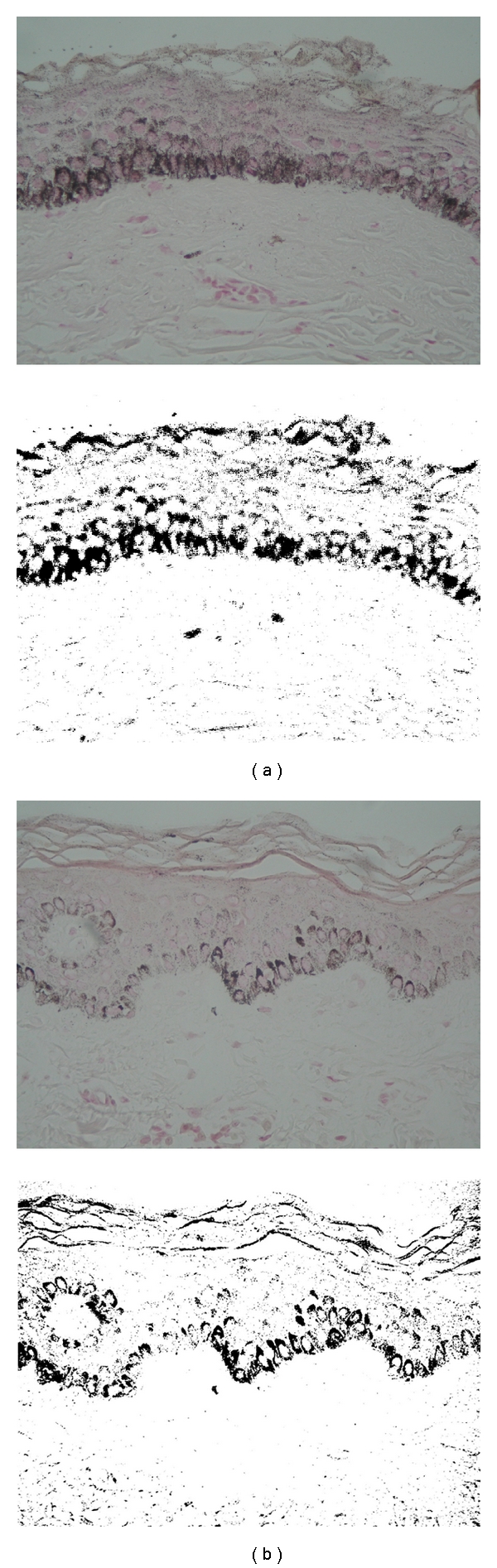
Fontana-Masson 조직 염색Fontana-Masson histology
시험 후 피부조직 검사에 참여한 11명 중, 논문이 대표 사례로 제시한 사용 전후 이미지다. 전체 참여자 27명의 평균적인 변화도, 한 사람에게 예상되는 결과도 아니다.
A representative before-and-after histology image presented within a post-treatment biopsy analysis of n=11. It is not the mean response of all 27 participants and does not predict an individual result.
Navarrete-Solis J 등, Figure 4. CC BY 3.0. 원본 그대로 사용. 나이아신아마이드 4% 크림을 8주간 사용하고 SPF 50+ 자외선차단제를 함께 사용한 조건.
Navarrete-Solis J et al., Figure 4. CC BY 3.0. Unmodified. 4% cream, 8 weeks, SPF 50+ co-use.
작동 원리는
어디까지 밝혀졌나
Mechanism is not
one proven causal chain
6일간 배양한 세포 실험 1건에서 세라마이드가 4.1~5.5배 증가했다. Ceramide 4.1 to 5.5-fold in one six-day cultured-cell experiment.
재구성 피부와 각질세포 외피를 평가한 결과다. 사람 피부의 실제 개선을 직접 측정한 것은 아니다. Reconstructed skin and corneocyte-envelope outcomes. Surrogate measures.
나이아신아마이드 3% 크림을 4주 사용한 연구다. 임상 증상의 개선을 직접 평가한 것은 아니다. A specific 3% cream over four weeks. Clinical symptom benefit was not directly measured.
피지 개선 효과는
연구마다 달랐다Sebum findings varied
by population and measure
논문에 제시된 집단 평균값을 다시 그린 그래프다. 오차 범위는 표시하지 않았다.Published means are reconstructed; uncertainty intervals are not plotted in this draft.
166.91
152.63
149.07
확인된 대상과
아직 모르는 영역Who was studied,
who remains unknown
연구에 포함된 사람들Directly represented
- 20~49세 일본 여성: 피지 변화
- 20~49세 미국 백인 여성: 피지 변화
- 40~60세 백인 여성: 피부결·잔주름 등 눈에 보이는 변화
- 25~53세 멜라스마 여성: 색소 변화
- Japanese women aged 20 to 49, sebum outcomes
- White US women aged 20 to 49, sebum outcomes
- White women aged 40 to 60, appearance outcomes
- Women aged 25 to 53 with melasma, pigmentation outcomes
이 글만으로 답할 수 없는 것Not established here
- 성별·연령·피부색에 따라 효과가 얼마나 달라지는지
- 청소년과 임신·수유 중인 사람에게 적절한 농도
- 피부질환을 치료하는 효과
- 10% 이상이 2~5%보다 더 효과적인지
- Relative effects by sex, age or skin tone
- Optimal concentration in adolescents, pregnancy or lactation
- Treatment efficacy for skin disease
- Whether 10% or more is better than 2% to 5%
성분 시험 결과와
실제 사용은 다르다Separate ingredient data
from general-use advice
CIR은 2005년 평가에서 당시 보고된 사용법과 농도 범위 안에서는 안전하다고 결론 내렸다. 다만 그때 화장품에 사용됐다고 보고된 최고 농도는 3%였다. 24명을 대상으로 10% 수용액을 8분간 시험한 미공개 산업 자료도 있지만, 이것만으로 씻어내지 않는 10% 완제품을 장기간 반복 사용해도 안전하다고 판단할 수는 없다.
The 2005 CIR assessment concluded safety under reported practices and concentrations, but the highest then-reported cosmetic concentration was 3%. An unpublished eight-minute test of a 10% aqueous solution in 24 people does not establish long-term repeat-use safety of a 10% leave-on product.
결과만큼
누가 연구했는지도 중요하다Read the findings
with their affiliations
| 연구Study | 공개된 산업계 연관성·보고 여부Reported industry link or reporting status |
|---|---|
| Hakozaki 2002 | 여러 저자가 P&G 소속이었다. 확인 가능한 초록에서는 별도의 이해관계 문구를 찾지 못했다.Multiple P&G-affiliated authors; no separate conflict statement identified in the accessible abstract |
| Navarrete-Solis 2011 | 대학·병원 소속 연구진이 수행했다. 원문에서는 연구비와 이해관계에 관한 문구를 확인하지 못했다.University and hospital authors; no funding or conflict statement identified in the article |
| Bissett 2004 | 모든 저자가 P&G 소속이었고, 기업 내부 영상 분석 알고리즘을 사용했다.All authors P&G-affiliated; internal image-analysis algorithms |
| Tanno 2000 | 모든 저자가 Kanebo 연구소 소속이었다.All authors affiliated with Kanebo research |
| Voegeli 2020 | DSM이 연구비 전액을 지원했다. DSM 직원·컨설턴트와 Newtone 직원이 저자에 포함됐다.Fully funded by DSM; DSM employees or consultant and a Newtone employee included |
| Draelos 2006 | 저자 3명 중 2명이 P&G 연구개발 부서 소속이었다.Two of three authors affiliated with P&G research and development |
| CIR 2005 | 여러 인체시험 자료가 P&G와 Unilever가 제출한 미공개 산업 자료에 근거했다.Several human safety data points relied on unpublished industry submissions from P&G and Unilever |
Cosmetic Ingredient Review(CIR)는 정부 규제기관이 아니다. 산업계가 관여했다고 해서 연구 결과가 곧바로 틀렸다는 뜻은 아니지만, 다른 연구진이 같은 결과를 재현했는지 판단할 때 반드시 살펴봐야 할 정보다.
The Cosmetic Ingredient Review is not a government regulator. An industry link does not make a result false, but it is necessary context when judging independent replication.
참고문헌References
- Hakozaki T, et al. Br J Dermatol. 2002;147(1):20-31. doi:10.1046/j.1365-2133.2002.04834.x.
- Navarrete-Solis J, et al. Dermatol Res Pract. 2011;2011:379173. doi:10.1155/2011/379173.
- Bissett DL, et al. Int J Cosmet Sci. 2004;26(5):231-238. doi:10.1111/j.1467-2494.2004.00228.x.
- Tanno O, et al. Br J Dermatol. 2000;143(3):524-531. doi:10.1111/j.1365-2133.2000.03705.x.
- Voegeli R, et al. Int J Cosmet Sci. 2020;42(6):632-636. doi:10.1111/ics.12666.
- Draelos ZD, et al. J Cosmet Laser Ther. 2006;8(2):96-101. doi:10.1080/14764170600717704.
- Cosmetic Ingredient Review Expert Panel. Int J Toxicol. 2005;24 Suppl 5:1-31. doi:10.1080/10915810500434183.
- U.S. FDA. How to Report a Cosmetic Product Related Complaint. Accessed 2026-09-11.
- American Academy of Dermatology. How to test skin care products. Accessed 2026-09-11.
- American Academy of Dermatology. How to maximize results from anti-aging skin care products. Accessed 2026-09-11.